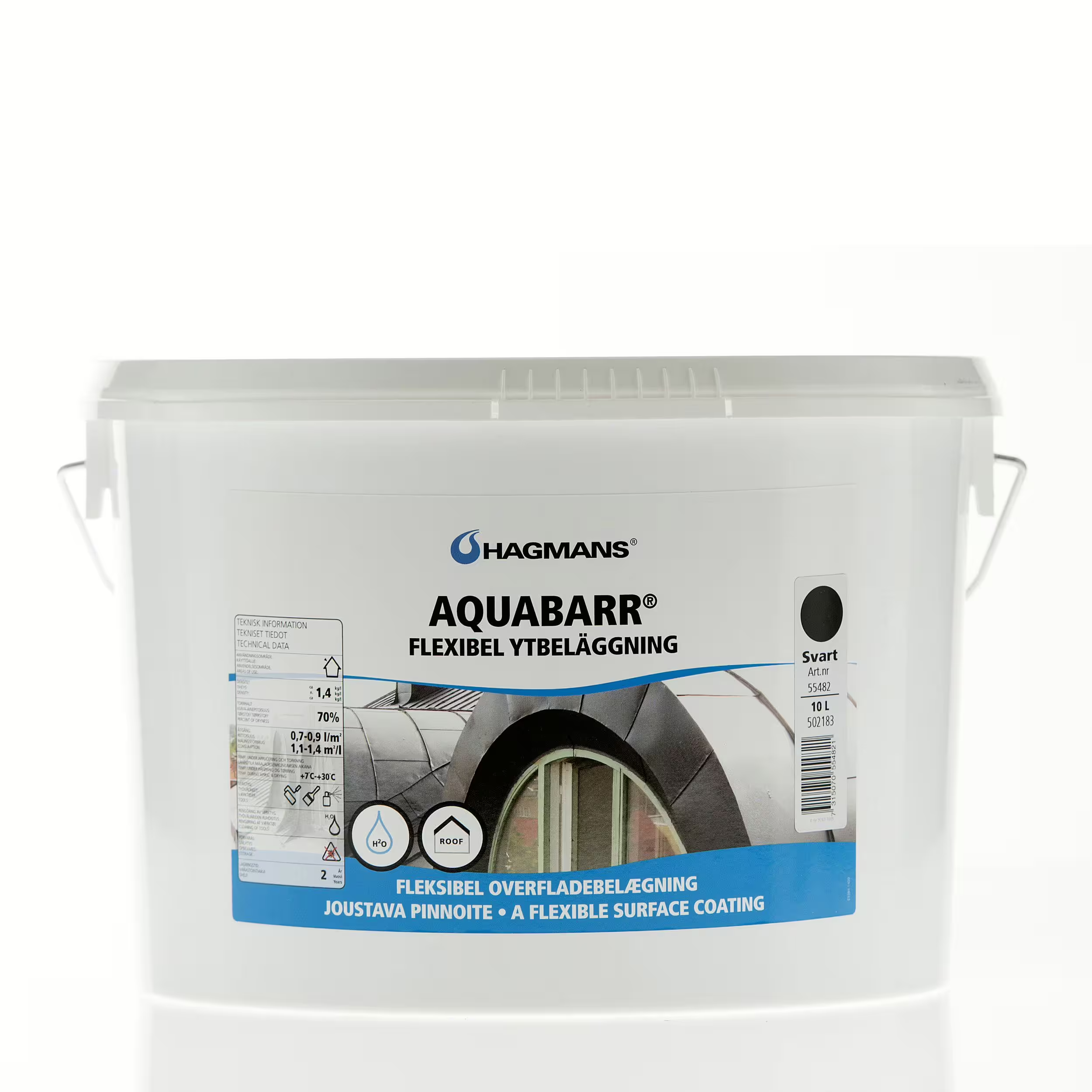
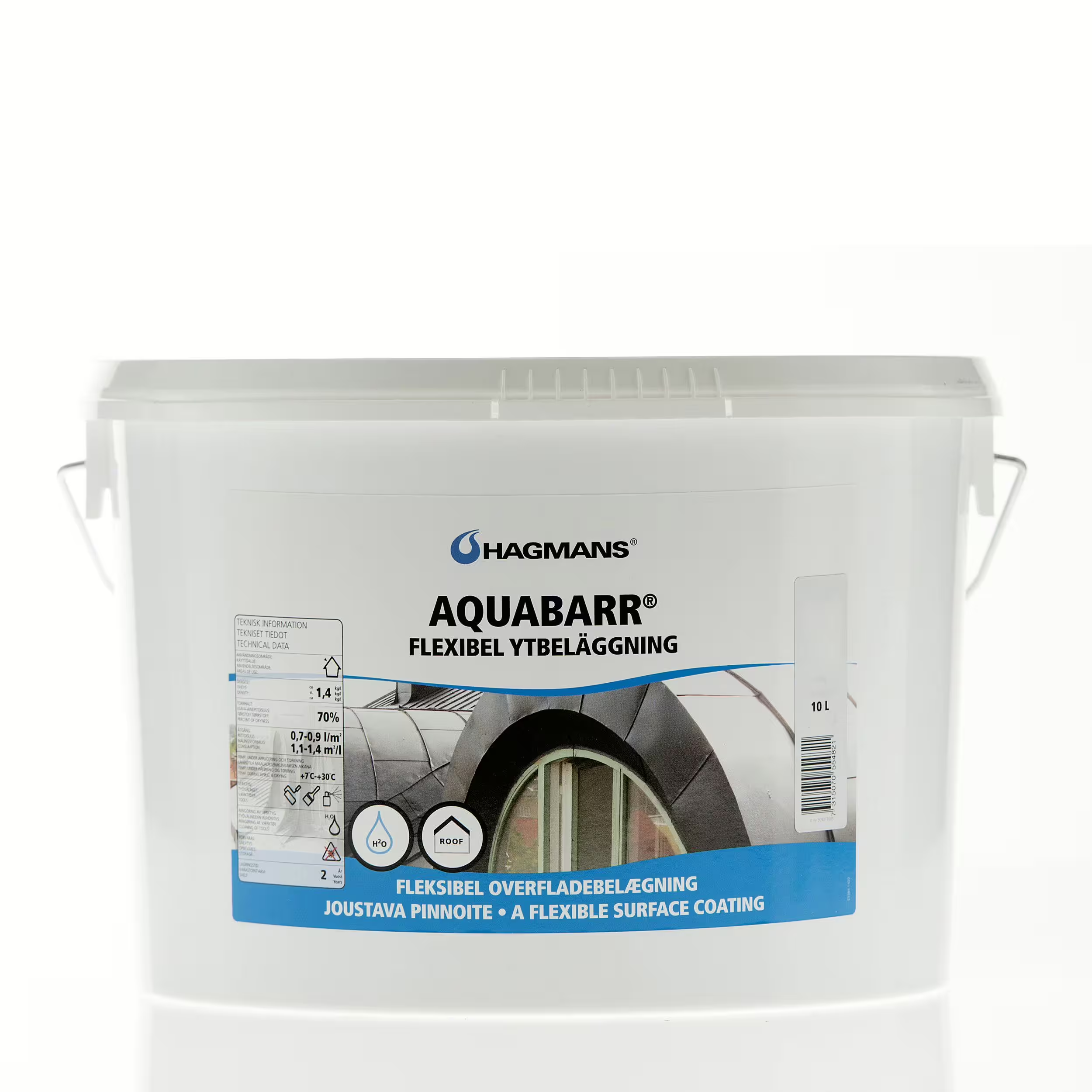
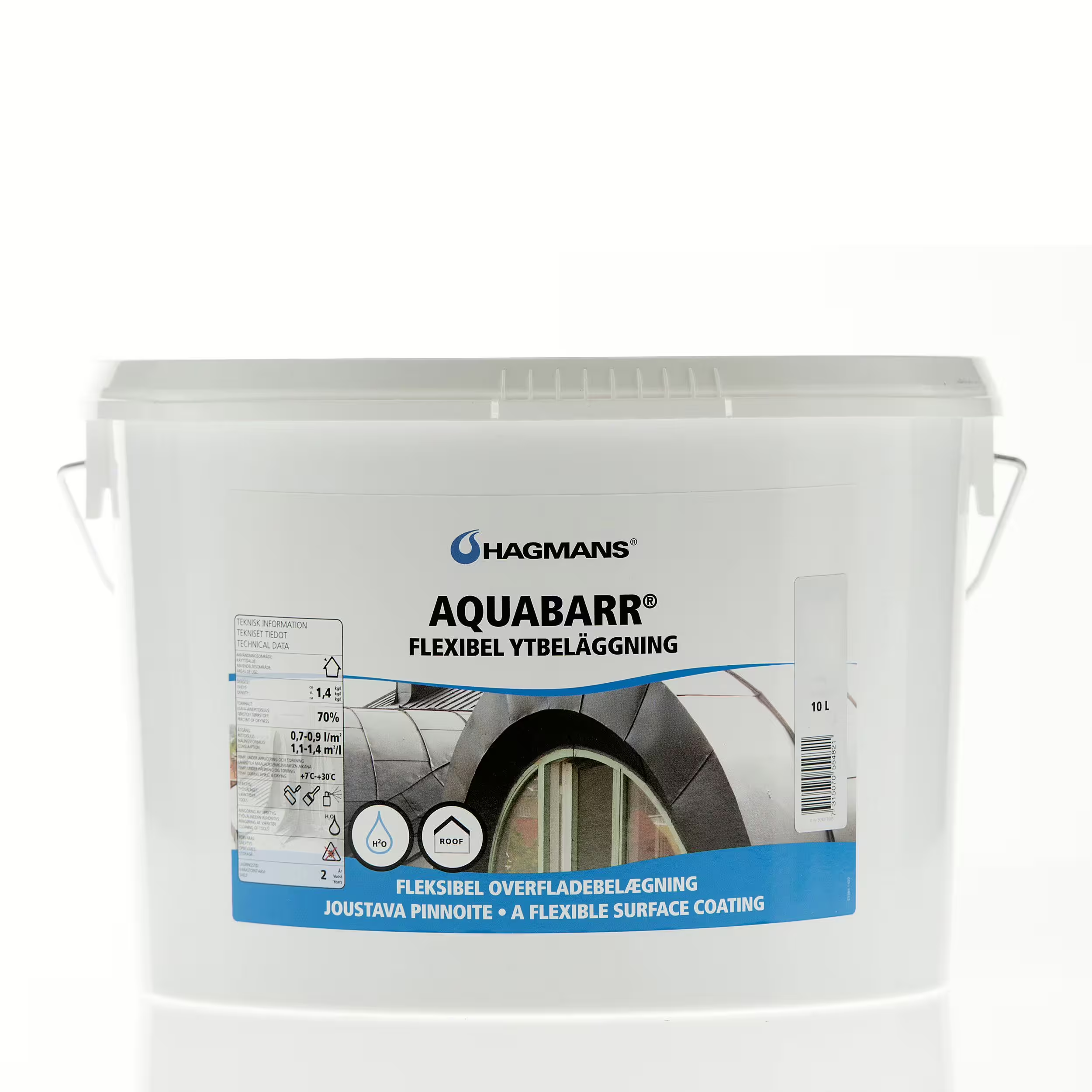
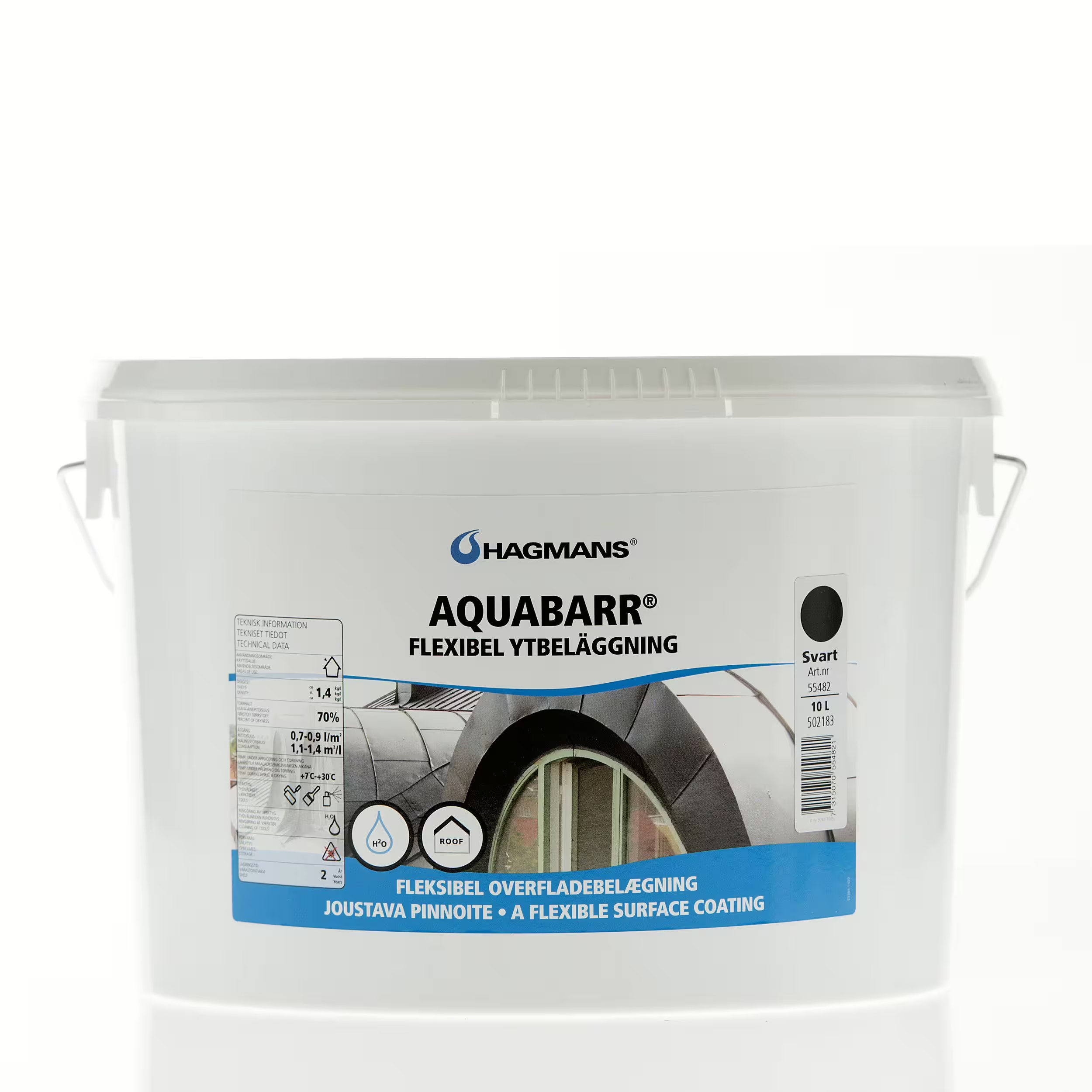
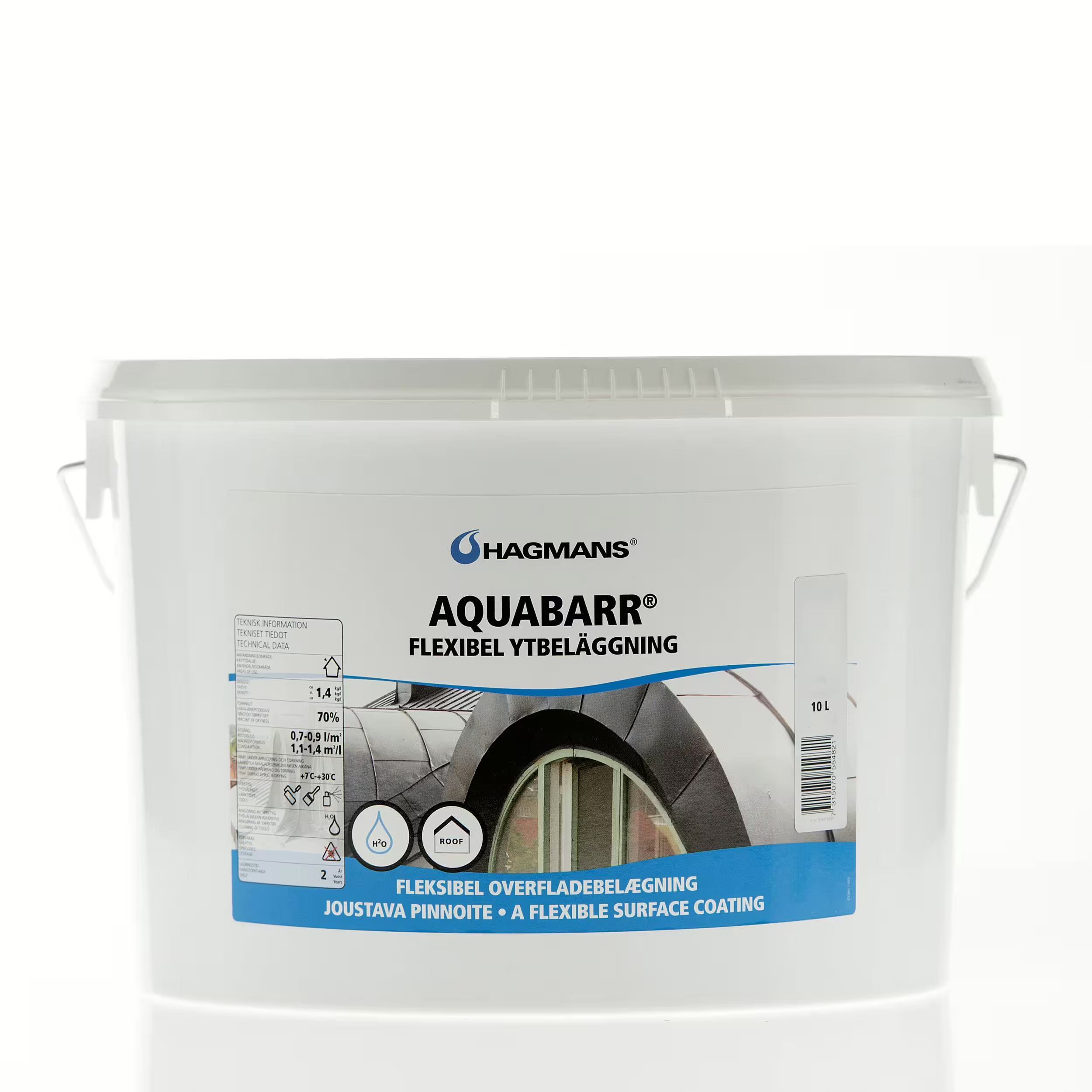
Flexible surface coating for outdoor use, joint-free polymer barrier.
- Flexible
- Low dirt pickup
- Alkali-resistant

Flexible surface coating for outdoor use, joint-free polymer barrier.
7-30°C
Acrylic
1.4 kg/l
6 hours between layers, 24 hours before walkable after the last layer.
5
At least 0.7 l/m² without reinforcement, at least 0.9 l/m² with reinforcement.
Water
50% %
70%
The material consumption without reinforcement should be at least 0.7 L/m², distributed over 2 coats. With reinforcement, the material consumption should be 0.9 L/m² in total, distributed over 3 coats. The material consumption varies depending on the surface structure, but this is the minimum recommended consumption for the coating to provide adequate protection. Drying time between coats is 6 hours at 20°C and 24 hours after the final coat. If reinforcement is used, a reinforcement mesh is applied. Using a spray makes it easy to apply the correct amount of AquaBarr. A brush or roller can also be used. Examples of suitable sprayers are Wagner PS 3.29 or PS 3.31 with Tempspray H226 equipped with nozzle 13 or 15. Other information: Work tools and similar equipment should be washed with water before the material has dried. Afterwards, e.g., with methylated spirits. Use the same batch number on a continuous surface. If the substrate temperature is higher than 40°C, application and adhesion are impaired. Pores or bubbles may form in the paint film.
Pre-treatment of sheet metal:
Cracks and holes are repaired with Hagmans Floor putty or
armor plate. The substrate must be clean, dry and firm.
Wash the surface with Hagmans Tak/Fasadtvätt. Chalking and oxidation (white rust) is cleaned with Hagmans Pickling liquid.
Glossy surfaces matt sanded. Rust damage is steel brushed/ground to clean metal and primed with Hagmans Plåtprimer.
Aluminum is primed with Hagmans Plåtprimer. At
repainting of previously painted surfaces is checked
adhesion. In case of poor adhesion, the paint layer must be
removed. Newer galvanized sheet metal and galvanized surfaces there
old paint removed must be baited with Hagmans
Biting liquid.
Pre-treatment of bitumen substrates:
Cracks and damage are repaired with Hagman's sealing tape.
When coating on bitumen substrates, for example
Hagmans Roofing Compound, Hagmans Roof Coating Paint must always be used to ensure adhesion and eliminate the risk of bleeding, this system must also be reinforced with armor plating. Cardboard roofs must be primed and reinforced over joints with reinforcing armor, if necessary, the entire surface must be reinforced.
Pre-treatment of untreated Eternit and Minerit:
Repair cracks and holes with Hagmans Floor Putty. Prime the substrate with Hagmans Roofing paint.
Pre-treatment of colored Eternit and Minerit:
Repair cracks and holes with Hagmans Floor Putty. Prime the substrate with Hagmans Golvimpregnering EP-V. (NOTE! maximum 12 hours between priming with Floor impregnation and coating with AquaBarr).
Pre-treatment of concrete:
Repair cracks and holes with Hagmans Floor Putty.
Concrete surfaces must be primed with Dambinnding 1K to improve adhesion to the substrate and facilitate the laying of Aquabarr. If necessary, joints can be reinforced with armour.
Pretreatment other:
Clean the substrate from loose material and deposits. If necessary, use Roof/Facade washing. The substrate must be moist but no free water. The temperature of the surface to be coated should be between 7-30°C.
We use AI to assist in the translation of product texts. Read more