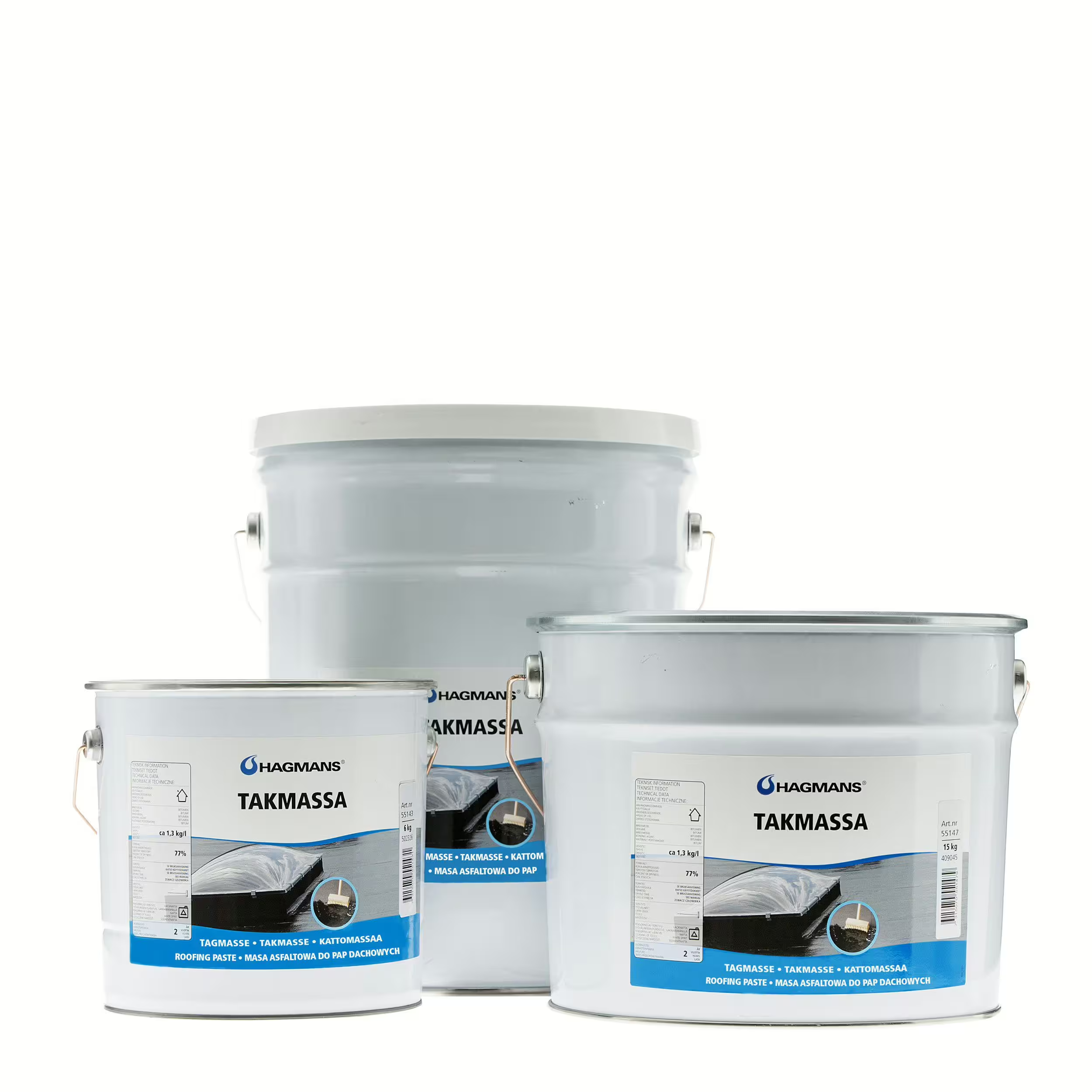
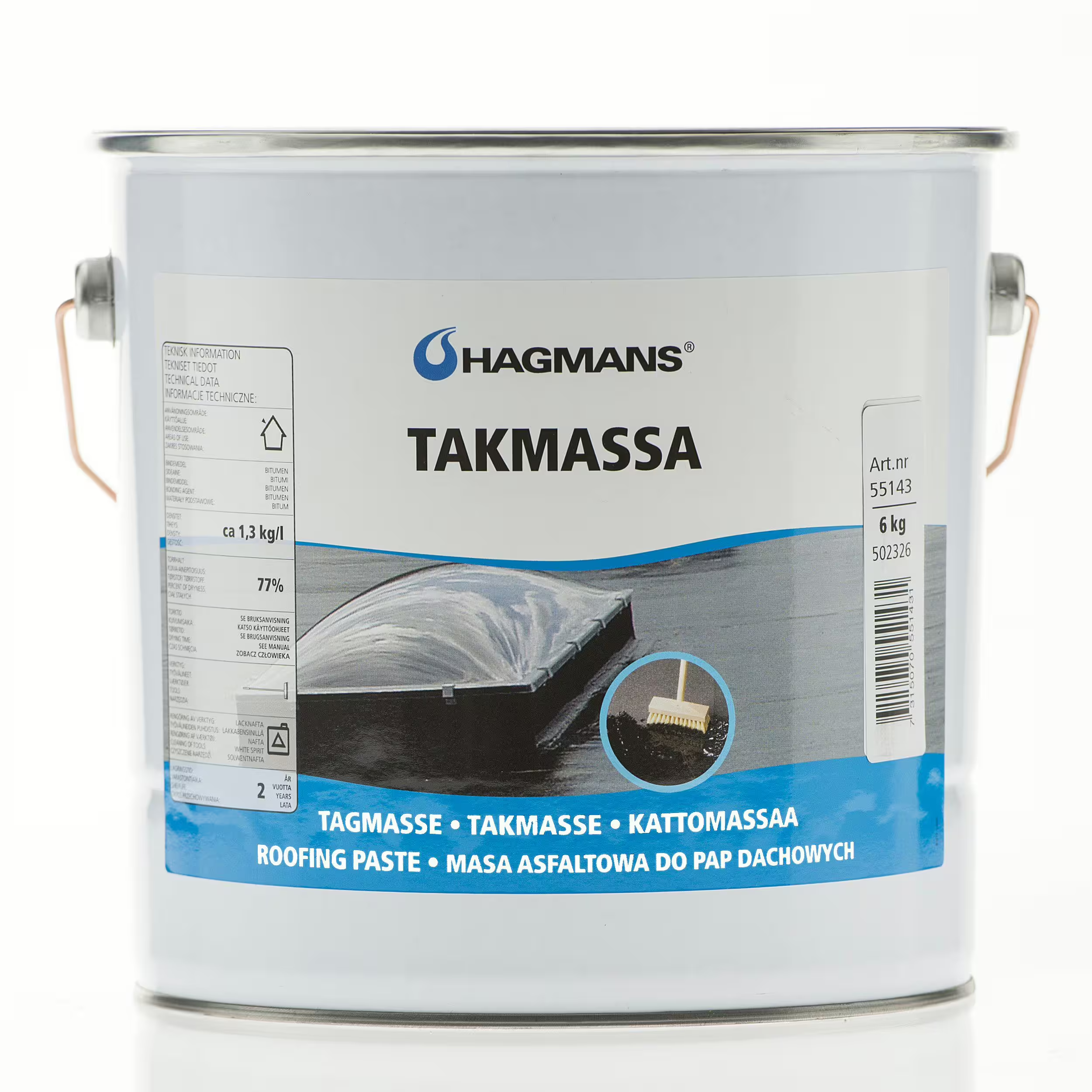
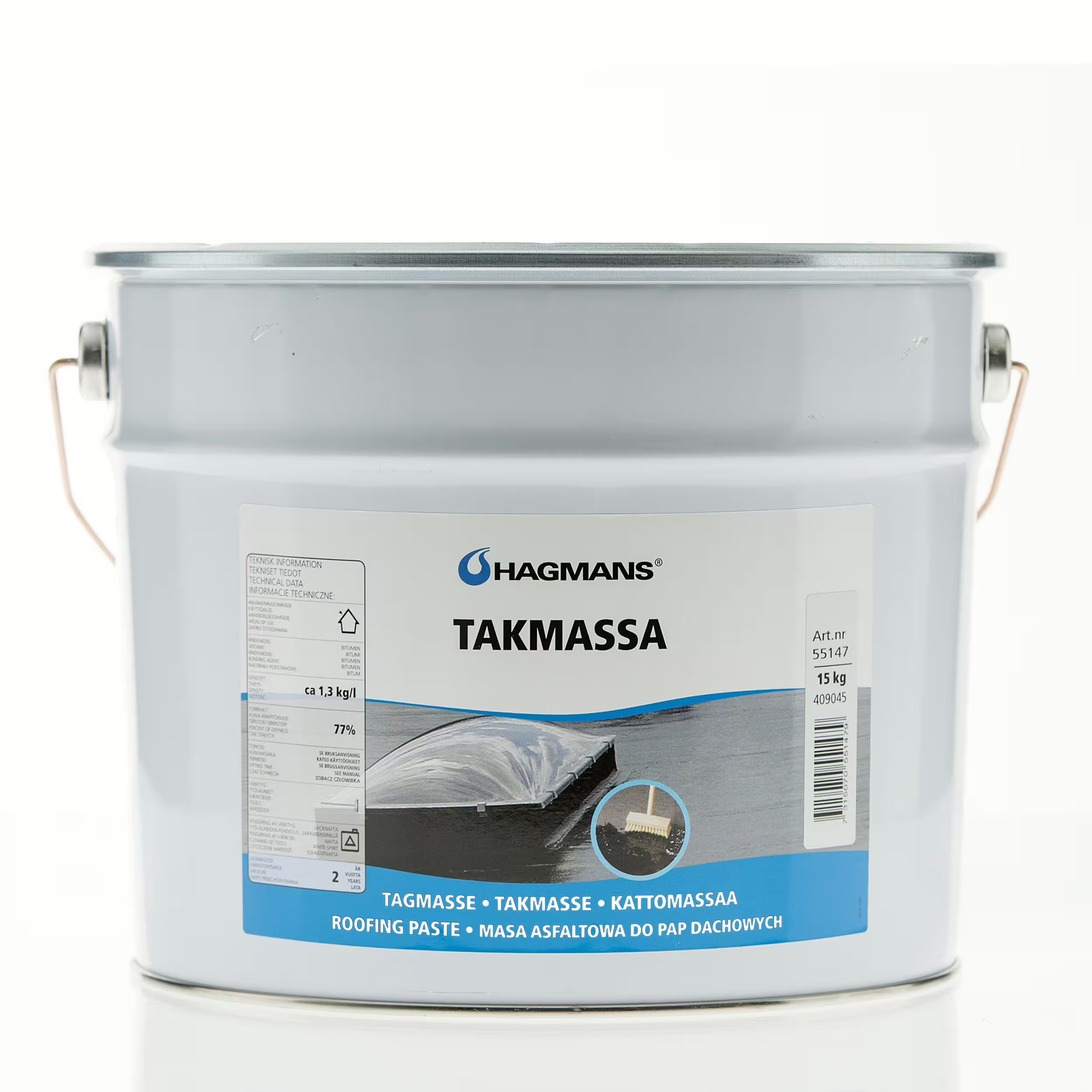
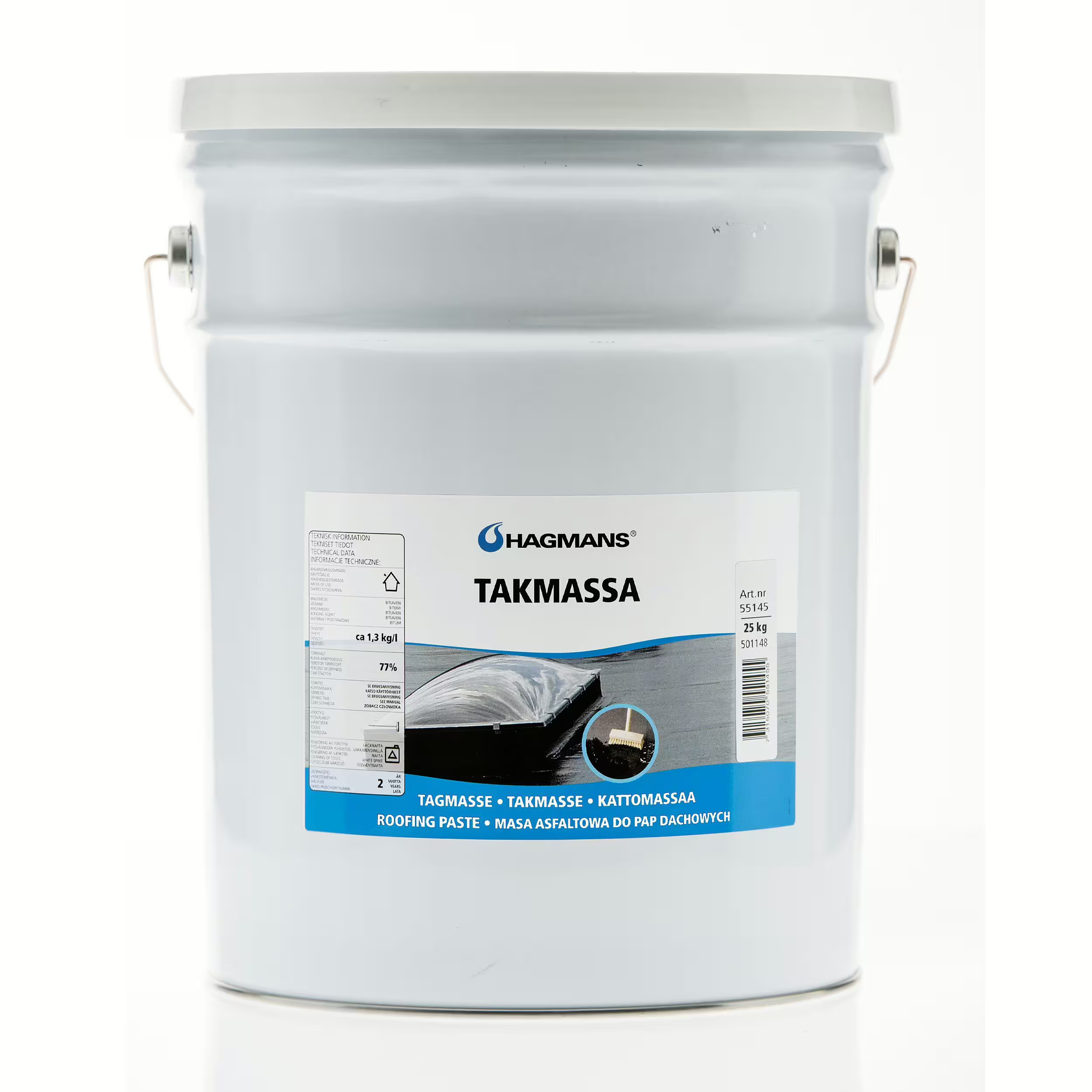
Bitumen-based, fiberglass-reinforced roofing compound for laying seamless waterproofing layers.
Hagmans
Takmassa
Additional information
Product information
-
Product description
Asphalt-based cold-application mastic with reinforcing fibers. Used as a single application to extend the durability of roofing felt. The roofing mastic together with reinforcing mesh was used to build a new seamless waterproof layer. -
Area of application
For the renovation of cardboard and metal roofs.
Technical information
-
Binder
Polymer-modified Bitumen
-
Density
About 1.3 kg/l
-
Drying time
At +15°C: Walkable within about 1 month.
-
Flammability
Fire class 2 b.
-
Flash-point
~ 40°C
-
Material consumption
Single coating Cardboard: approx. 1 m²/kg (Depending on surface texture and cardboard quality.) Metal sheet: approx. 1.25 m²/kg
-
Vapor diffusion (sd)
The roof compound is diffusion-proof
-
Weight Solids
77%
Application
-
Instructions for use
Single ironing – Tin roof
The roofing compound is normally applied with a roof brush
combination with brush for edging.
Material consumption 1.25 m²/kg.
Single ironing – Cardboard roof
The roofing material is usually spread with a roofing brush
in the lengthwise direction of the cardboard and towards the overlap so
that the joint is filled. Assignments should be terminated
with a straight edge approx. 5 cm up. Keep in mind that
long brush strokes provide a smoother surface. Use
amount of material should be approx. 1 m²/kg, depending
on surface structure and cardboard quality.
Full reinforcement – Cardboard roof:
The first layer is laid out in the same way as
general ironing. The material consumption should be
approx. 1 m²/kg, depending on the surface structure and
cardboard quality. The roofing compound is applied at least equally
as wide as the width of the reinforcement mat. It gets
there are no "strips" without roofing material in the joint.
The reinforcement is inserted and properly stretched
that no creases occur. The reinforcement must always
take place in the underlying paper
longitudinal direction. The entire surface must be "ironed over"
with the brush so that the reinforcement is pressed down
the roof mass. There must be no air pockets.
Finally, a comprehensive layer is laid
with roofing material (approx. 0.7-0.8 m²/kg). The reinforcement
overlap by 5 cm. The upper layer
roofing material is spread with long brush strokes so that
the surface will be as smooth as possible. At connections
the reinforcement is placed a few cm so that
the cardboard fold is reinforced and the risk of leakage
is minimized. Hoods, booties and other details
is completely ironed out or the roofing material is pulled up approx. 5
cm and ends with a straight edge. -
Pretreatment
Metal Roof: Clean the roof of dirt and remove any old paint and rust by scraping or blasting. Prime rust-affected metal surfaces with Hagmans Metal Primer. Cracks and holes can be easily repaired with Hagmans Asphalt Putty or Hagmans Asphalt Adhesive. Larger repairs are reinforced with Hagmans Reinforcement Mat.
Felt Roof: The substrate must be thoroughly cleaned and dry. Moss and algae must be removed. Blisters or similar defects in the felt should be adjusted so that the surface is smooth enough to achieve a good result. Remember to check and, if necessary, adjust any felt pockets that may occur at the upstands in the old roofing felt. Larger damages and cracks over beams are reinforced with Hagmans Reinforcement Mat. Movement cracks are bridged with a release strip of SBS mat. -
After painting
Color: Black (slate gray over time). The roof surface must be dry during the work. Rain immediately after the roof treatment has no effect on the roof compound's tightness. Only minor changes in the surface layer may occur. The roof should not be walked on before the roof compound has stabilized. This takes about 2 months for full reinforcement.
Documents
We use AI to assist in the translation of product texts. Read more