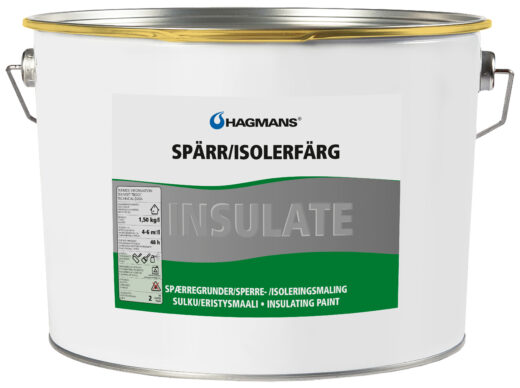
Matte waterborne and reflection-free roof paint with high coverage.
- Non-reflective
- Excellent coverage
- Does not splatter

Matte waterborne and reflection-free roof paint with high coverage.
Indoors
VAE
White
24 hours (At 23°C and 50% RH)
1.4 kg/L
1 hour (At 23°C and 50% RH)
Not flammable
1, matte
Class 2, EN 13300
7-9 m²/l
2 hours (At 23°C and 50% RH)
Minimum +5°C
Water
Brush, Roller, Spray
(Cat. A/a): <30 g/l
32 %
Class 3, EN 13300
Always start by reading the instructions on the paint can and remember to be thorough from the start. Good tools and careful sub-work are the prerequisites for a successful painting result. Stir the paint well from the bottom before you start painting.
Room and surface temperature is also important for the final result. Do not paint if it is colder than +5°C.
The substrate must be clean, dry and firm. Wash previously painted surfaces with paint cleaner and rinse with water. Chalky substrates, such as lime and adhesive paint ceilings, should be washed and primed with Blocka barrier paint before painting. Glossy alkyd-painted surfaces are matt-sanded before painting. Any iron such as nail heads etc. is first primed with a suitable anti-rust paint.
When painting over the paper wallpaper, test first so that the wallpaper does not come off when painting with water-based material. In such cases, prime first with a suitable barrier paint. This is also recommended when painting heavily discolored surfaces, eg nicotine, soot and water damage.
Remember to properly protect the floor and furniture before you start painting.
Paint at least 2 times for full coverage with a roller, brush, or – after thinning – with a spray. The ceiling surfaces should always be painted generously with a lot of paint on the roller to avoid seams and streaks. Always paint the ceiling in a cross pattern and the entire ceiling/wall at the same time. Since the paint has a certain texture when rolled to create a smooth and concealing surface, the paint should be leveled after being evenly distributed on the surface. This means, when painting, for example, ceilings, after spreading the paint on the surface, the roller should be drawn in the same direction, with the same pressure and speed, in the wet paint. All the peaks will then settle uniformly in the same direction with the final smoothing stroke towards the main light source. This avoids the light being differently shadowed on the surface, which can give a blotchy appearance.
Tool cleaning: Water. Remove as much paint as possible before cleaning. Storage: Cool and frost-free. Environment: Protect skin and eyes from splashes. Avoid inhalation of spray mist and sanding dust. Paint and cleaning liquids must not be released into drains, but collected and disposed of as environmental waste. Empty and dry packaging should be sorted as plastic, metal handles should be removed and sorted as metal.
The surface can be wiped with a dry cloth if necessary. Never use alcohol when cleaning co-polymer paints. Black marks from metal scraping are best removed with an eraser.
We use AI to assist in the translation of product texts. Read more